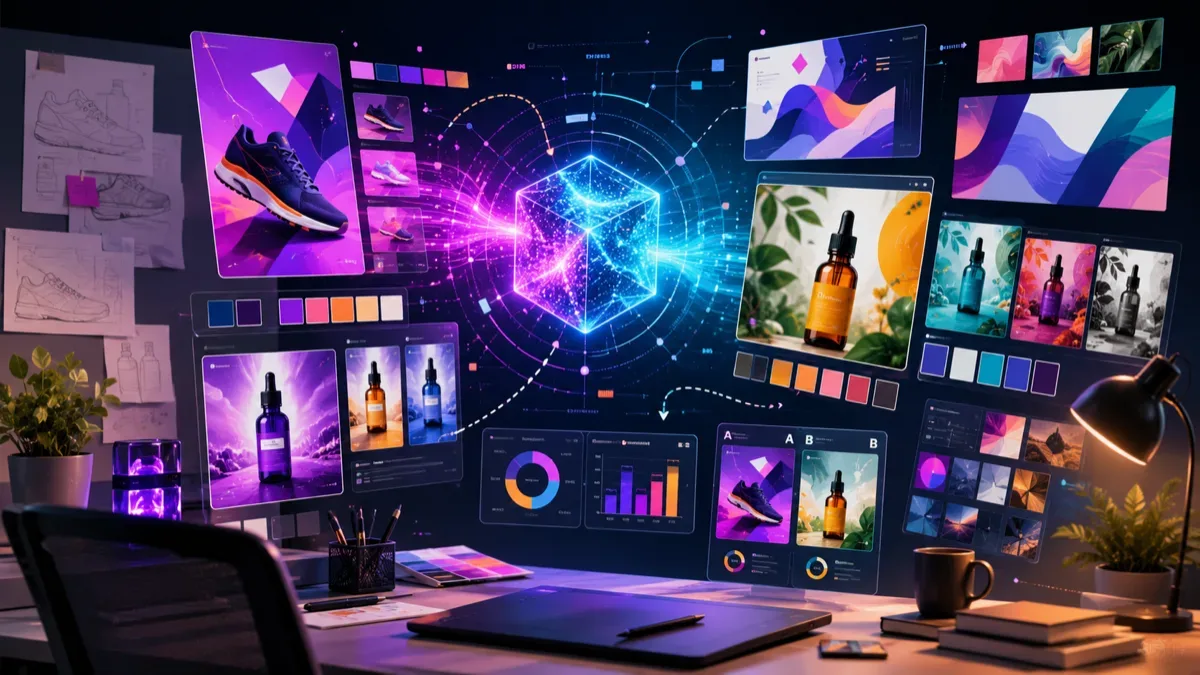
Ad creatives often fail because testing is too slow. A team needs to compare offers, visual directions, formats, and hooks. If every option requires a full design cycle, many useful hypotheses never get tested.
AI image and video generation can speed up the early stage. Tools such as AiHere make it possible to generate ad concepts, covers, banners, and short clips from structured prompts.
Where AI Helps Most
AI is useful when you need variety:
- visual directions for one product;
- different backgrounds and moods;
- short vertical video concepts;
- covers for social ads;
- landing page illustrations;
- product scenes;
- moodboard references.
The goal is not to replace design judgment. The goal is to create enough options to see which direction deserves more work.
Start With the Offer
A weak offer cannot be fixed by a beautiful image. Before generating visuals, define the value proposition: who the ad is for, what problem it solves, and why the viewer should care now.
Weak prompt:
Create an ad banner for an AI service.Stronger prompt:
Create a visual concept for an AI tools service. Audience: Telegram channel owners and marketers. Main idea: create text, images, and videos in one workspace. Style: modern interface, clean background, sense of speed and control, no text in the image.The second prompt gives the model a marketing angle, not only a visual request.
Static Creatives
For static creatives, generate images without text whenever possible. Add copy later in a design editor. This avoids broken lettering and gives better control over layout.
A useful prompt structure:
- product or situation;
- target audience;
- emotion;
- visual style;
- color accents;
- restrictions such as no text or no logos.
For testing, create several directions instead of one polished image: minimal interface, abstract metaphor, product scene, before-and-after, human-focused visual, and editorial style.
AI Video for Ads
Short AI videos are useful for testing attention. Keep the scene simple: a dashboard lights up, content cards arrange themselves, a product interface appears, or the camera moves toward the main object.
If a static cover already works, animate it with image-to-video. This often produces more predictable results than asking the model to invent the whole scene from scratch.
Creative Testing
AI speeds up production, but the result still needs review. Check:
- whether the benefit is clear in two seconds;
- whether the visual is too crowded;
- whether the creative matches the landing page;
- whether there are strange details;
- whether the format fits the platform;
- whether the ad follows platform rules.
Small tests are easier to interpret: three offers multiplied by three visual directions usually teach more than dozens of random assets.
Bottom Line
AI for ad creatives is valuable as a hypothesis engine. It helps marketers produce more options, compare directions faster, and spend design time on the best candidates.
The practical order is simple: define the audience and offer first, generate visual directions second, and polish only what shows promise.
FAQ
Can AI creatives be used in real campaigns?
Yes, especially for early testing, visual concepts, covers, banners, and short videos. Final assets still need brand review and platform compliance checks.
What matters more: the prompt or the offer?
The offer matters more. A strong visual can attract attention, but campaign performance depends on the audience, value proposition, landing page, and timing.
Should AI add text to ad images?
In most cases, generate the image without text and add copy later in a design editor. This gives better control and avoids broken lettering.