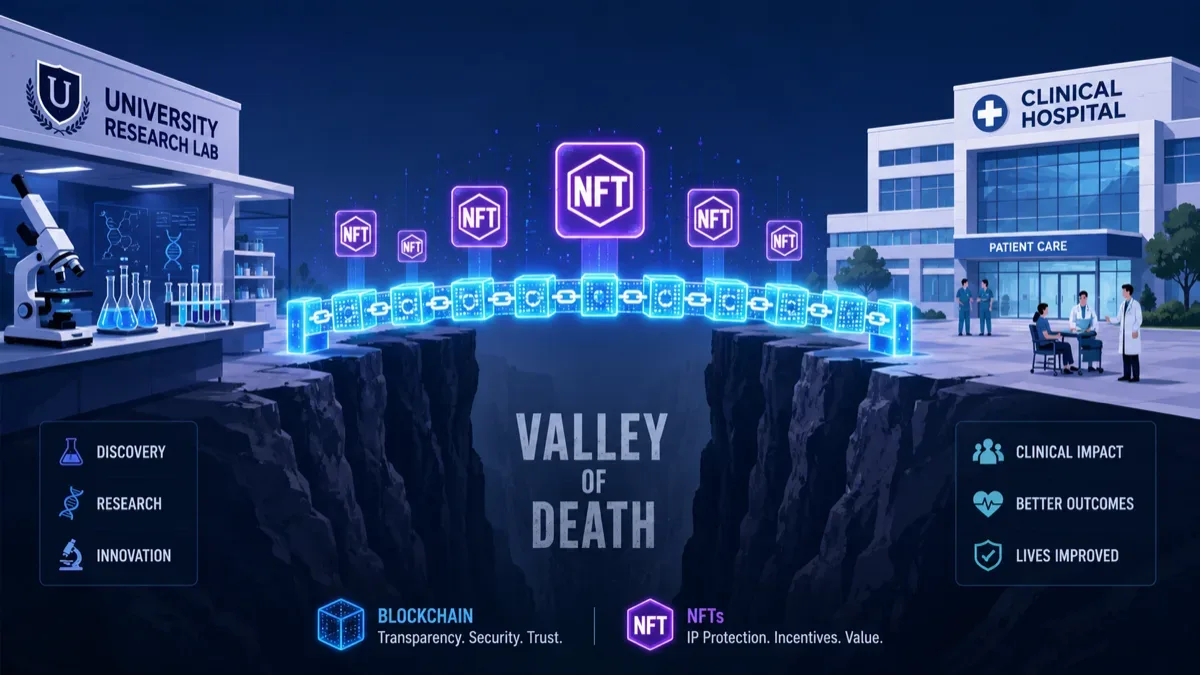
The traditional pathway for bringing a new drug to market is notoriously broken. Known in the biotech industry as the “Valley of Death,” the phase between basic laboratory discovery and early-stage clinical trials is where over 90% of promising therapeutic compounds go to die.
For longevity science (LongBio), this valley is even wider and deeper. Because regulatory bodies like the FDA do not currently classify aging as a disease, traditional pharmaceutical giants and venture capital firms rarely fund early-stage preventative treatments (geroprotectors). They prefer late-stage, single-disease interventions that promise immediate, predictable returns.
Enter Decentralized Science (DeSci). By leveraging blockchain technology, intellectual property tokenization, and global web3 communities, DeSci is bypassing traditional institutional bottlenecks. This movement is democratizing how scientific research is funded, conducted, and owned.
The Core Bottleneck: Why Longevity Research Starves
To understand why DeSci is gaining rapid traction, we must look at the structural failures of traditional scientific funding:
- The Grant Cycle Trap: Academic researchers spend up to 40% of their time writing grant applications instead of doing science. These grants are typically awarded by centralized committees that favor safe, incremental studies over high-risk, high-reward breakthroughs.
- Intellectual Property Silos: Patents are locked inside university Technology Transfer Offices (TTOs). Negotiating the rights to a compound can take years, stalling potential clinical trials.
- Lack of Public Alignment: The public—the ultimate consumers of these therapies—has zero say in which diseases are prioritized and no financial upside if a drug succeeds.
DeSci rewrites this playbook by replacing centralized gatekeepers with decentralized autonomous organizations (DAOs) and liquid IP markets.
The DeSci Toolkit: IP-NFTs and IPTs
At the heart of the DeSci revolution is a novel financial and legal primitive: the IP-NFT (Intellectual Property Non-Fungible Token), pioneered by the web3 protocol Molecule.
An IP-NFT is a digital wrapper around a real-world legal agreement. It links a blockchain token directly to intellectual property rights, pre-patent data, or research agreements (such as Sponsored Research Agreements, or SRAs) held by a university or lab.
How the IP-NFT Pipeline Works:
- Step 1: The Proposal. A researcher submits a project proposal to a DeSci platform.
- Step 2: Tokenization. The research project’s future IP and data rights are minted as an IP-NFT on-chain.
- Step 3: Funding. A DAO or a group of web3 investors purchases the IP-NFT, instantly transferring capital to the lab.
- Step 4: Fractionation (IPTs). The IP-NFT can be fractionated into fungible IP Tokens (IPTs). This allows a broader community of patients, researchers, and enthusiasts to own governance rights over the IP, vote on how the data is utilized, and share in future licensing revenues.
This model completely bypasses the bureaucratic friction of university TTOs, turning illiquid scientific assets into liquid, tradeable, and collaborative digital primitives.
VitaDAO: A Case Study in On-Chain Longevity Funding
VitaDAO is the world’s premier DeSci community dedicated to funding early-stage longevity research. Governed by holders of the $VITA token, the DAO has established a highly efficient, community-driven pipeline for evaluating and funding scientific hypotheses.
As of mid-2026, VitaDAO’s real-world impact is undeniable:
- 31+ Projects Funded across target discovery, drug discovery, and preclinical development.
- $4.7M+ in Funding Deployed directly to laboratories globally.
- 8 IP-NFTs (IPTs) Generated, creating a diversified portfolio of longevity assets.
- 3 Biotech Companies Founded based on DAO-funded research.
Real-World Projects Funded by VitaDAO:
- ARTAN Bio ($91,300): Developing mutation-specific codon suppression therapies to combat genetic and age-related diseases caused by premature stop codons.
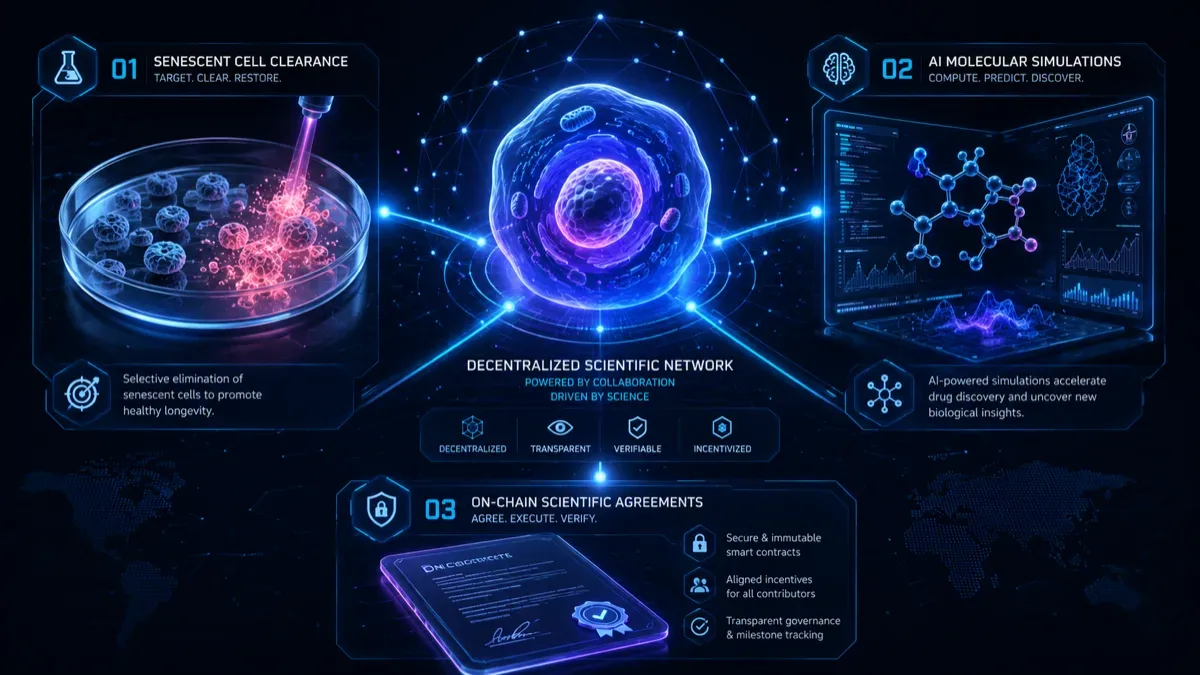
- Rubedo Life Sciences ($350,000): A prodrug discovery platform targeting senescent cells (zombie cells that drive chronic inflammation and tissue degradation).
- Korolchuk Lab ($285,000): Researching novel autophagy activators to help cells clear out molecular waste, a key hallmark of aging.
AI-Driven Science Acceleration
To scale their operations, VitaDAO has integrated advanced AI agents into their workflow. LAIA (Longevist AI) automatically curates longevity preprints daily, generates research hypotheses, and assists in evaluating incoming project proposals. Meanwhile, AubrAI (an AI specialist trained on the work of longevity pioneer Aubrey de Grey) provides the community with instant, expert-level answers to complex biomedical questions.
How You Can Participate: A Practical Guide
For the first time in history, ordinary individuals do not have to wait for pharmaceutical conglomerates to develop life-extending therapies. You can actively fund, govern, and benefit from the frontier of LongBio.
Step 1: Set Up a Secure Web3 Wallet
To interact with DeSci protocols, you need a secure, non-custodial wallet.
- For maximum security, use a hardware wallet like Trezor, Tangem, or Keystone.
- For daily interactions and multi-signature security, set up a smart contract wallet using Safe or Argent.
Step 2: Join a DeSci DAO
Acquire governance tokens (such as $VITA) to participate in the DAO’s decision-making process. Token holders can vote on which research proposals receive funding, review scientific data, and help steer the direction of the organization.
Step 3: Invest in IP Tokens (IPTs)
Through platforms like Molecule Labs, you can purchase fractionated IP tokens of specific research projects. If a molecule you funded successfully passes clinical trials or is licensed by a major pharmaceutical company, the value of your IPTs reflects that success.
Step 4: Track Your Own Longevity Biomarkers
As you support the development of new molecules, you can monitor your own biological age using advanced epigenetic testing kits from TruDiagnostic (which utilizes the highly accurate DunedinPACE algorithm) or Elysium Health.
Risks, Challenges, and the Road Ahead
While DeSci offers an incredibly promising alternative to traditional biotech funding, it is not without significant hurdles:
- Regulatory Uncertainty: The intersection of securities laws and decentralized governance is highly complex. Molecule’s recent legal frameworks—such as the “Coin-to-Company” model published in March 2026—attempt to solve this by creating compliant pathways to transition decentralized communities into traditional equity structures under U.S. law. However, regulatory scrutiny remains high.
- Scientific Risk: Drug development is inherently risky. A compound that looks miraculous in a petri dish or in mice has a high probability of failing in human clinical trials. DeSci investors must be prepared for the reality that many funded projects will yield negative results.
- Liquidity and Valuation: Valuing early-stage, pre-patent scientific data is incredibly difficult. The market for IPTs is still highly illiquid compared to mainstream crypto assets.
The Verdict: A New Paradigm for Human Healthspan
DeSci is more than just a novel fundraising mechanism; it is a fundamental realignment of incentives. By connecting passionate global communities directly with cutting-edge researchers, protocols like Molecule and DAOs like VitaDAO are dismantling the ivory towers of academia and the closed doors of big pharma.
In a world where aging is the leading cause of disease and suffering, accelerating the translation of basic science into clinical trials is not just a financial opportunity—it is a moral imperative. Through DeSci, the crowd now has the power to fund the cure.